Universal Quantum Combines Ion Trap, Controls and Modular Links in New Chip


Insider Brief
- Universal Quantum launched the iQPU, a trapped-ion quantum processor that integrates control technology and modular connections to support manufacturing and scaling.
- The chip is fabricated on a commercial semiconductor foundry line and uses UQConnect interfaces to link processors into larger systems.
- Universal Quantum plans to integrate the iQPU into customer systems, including two quantum computers under €67 million in contracts with the German Aerospace Center.
PRESS RELEASE — Universal Quantum launches the iQPU, an integrated quantum processing unit designed to make quantum computers practical to manufacture, scale and deploy cost effectively. Combining the largest trapped-ion compute surface with built-in ultra-low noise control technology and modular chip-to-chip interconnect (UQConnect) interfaces, the iQPU addresses some of quantum computing’s hardest scaling challenges and is a key puzzle piece of UQ’s route to utility scale quantum computing.
Quantum computing has advanced rapidly, but most systems were not designed to scale from the outset. As qubit numbers grow, each increase can demand substantial redesign across the architecture. Universal Quantum created the iQPU with a different philosophy: scaling is engineered into the system from the ground up.
“The question is no longer whether quantum computing can work, but how we build enough high-quality qubits to solve problems that matter,” said Sebastian Weidt, CEO and Co-Founder of Universal Quantum. “The iQPU allows us to combine our world record interconnect technology with a chip architecture that can control qubits at scale and is manufactured in commercial silicon foundries. It opens up an exciting route for us from today’s systems to the utility-scale quantum computers the world needs.”

The opportunity is substantial. McKinsey forecasts that quantum technologies could generate $60–100 billion in annual revenue by 2035 and create up to $2.7 trillion in economic value across industries including pharmaceuticals, finance and automotive. Reaching that potential depends on moving beyond small experimental machines to reliable systems with enough high-quality qubits for useful work.
Universal Quantum has focused from the outset on solving scale. Its trapped-ion architecture is designed to support fault-tolerant quantum computers for applications that could include drug discovery, battery and materials design, climate modelling and financial services. The company’s progress was recently recognised via a $100m Series A funding round from a global syndicate of sovereign, institutional, deep tech and quantum-specialist investors.
A chip built to scale quantum compute
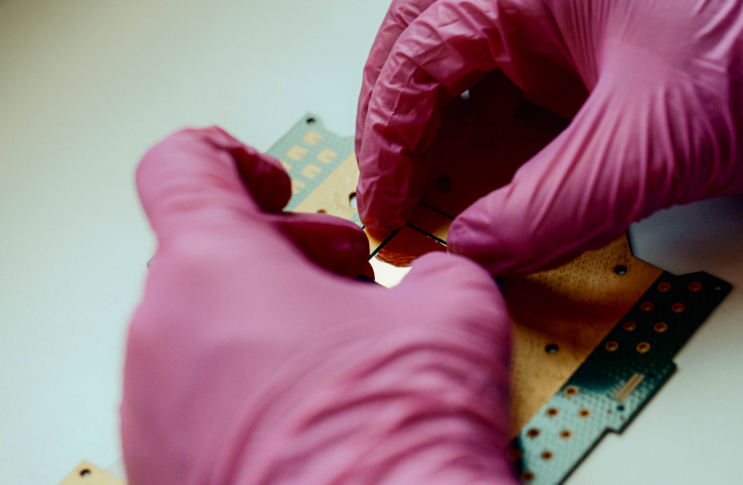
At the centre of the platform is the iQPU: a trapped-ion processor chip with an active compute area of more than 400 mm². Its Quantum Charge-Coupled Device (QCCD) architecture moves ions across the chip, enabling flexible, long-range connections between qubits rather than fixing each qubit to a single location. This approach reduces the number of qubits required to solve commercial problems and speeds up computations.
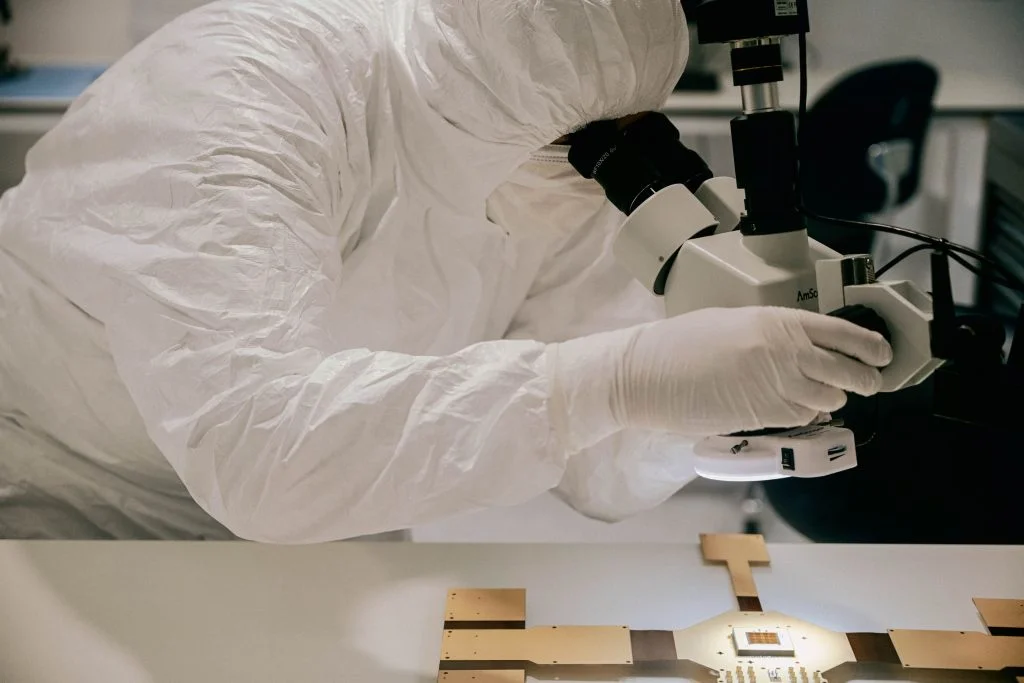
The processor is fabricated on a commercial 200 mm semiconductor foundry line using industry-standard design and manufacturing tools. This matters because scaling quantum computers requires more than a larger experimental device: it requires components that can be produced repeatedly and at low cost, tested reliably and integrated through mature supply chains.
UQConnect, Universal Quantum’s world record modular interconnect technology, allows separate processors to exchange quantum information and operate as one larger computer. Instead of redesigning the entire machine whenever more capacity is needed, additional iQPUs can be connected using the same underlying architecture.
The result is a complete scaling strategy. The iQPU provides the repeatable unit of quantum computation; integrated control reduces the amount of external hardware needed to operate it and addresses the ‘wiring problem’; and UQConnect supplies the links between modules. The architecture is designed to support efficient error correction while avoiding the impractical growth in wiring, lasers and cooling infrastructure that can accompany other approaches.
“A scalable quantum computer cannot be assembled by adding complexity one qubit at a time,” said Mike Newman, VP of Engineering at Universal Quantum. “We have brought the ion trap, control electronics and modular connections together in one chip, so the same engineered unit can be manufactured, tested and connected repeatedly to scale to much more powerful quantum computers. That is what turns scale from a scientific aspiration into a practical systems challenge we can solve.”
Built for customer programmes
The iQPU will be integrated into the systems Universal Quantum is currently building for its customers including for the German Aerospace Center (DLR). The €67 million contracts for two scalable quantum computers will support the DLR in exploring applications including space mission planning, climate modelling and materials design.
Alongside its work to solve scale, Universal Quantum’s “change world” focus includes working with its commercial and academic partners to unlock world changing value and directing quantum innovation towards challenges with meaningful social impact. For example, through its collaboration with the Open Quantum Institute, the company is exploring potential quantum applications in areas including endometriosis research.

Keep track of everything going on in the Quantum Technology Market. In one place.
Topics

Matt Swayne
With a several-decades long background in journalism and communications, Matt Swayne has worked as a science communicator for an R1 university for more than 12 years, specializing in translating high tech and deep tech for the general audience. He has served as a writer, editor and analyst at The Quantum Insider since its inception. In addition to his service as a science communicator, Matt also develops courses to improve the media and communications skills of scientists and has taught courses.
[email protected]

Stay Ahead of Quantum
Get the latest research, company news, and market intelligence every week.
MENTIONED IN THE ARTICLE